Navimow i105N Review
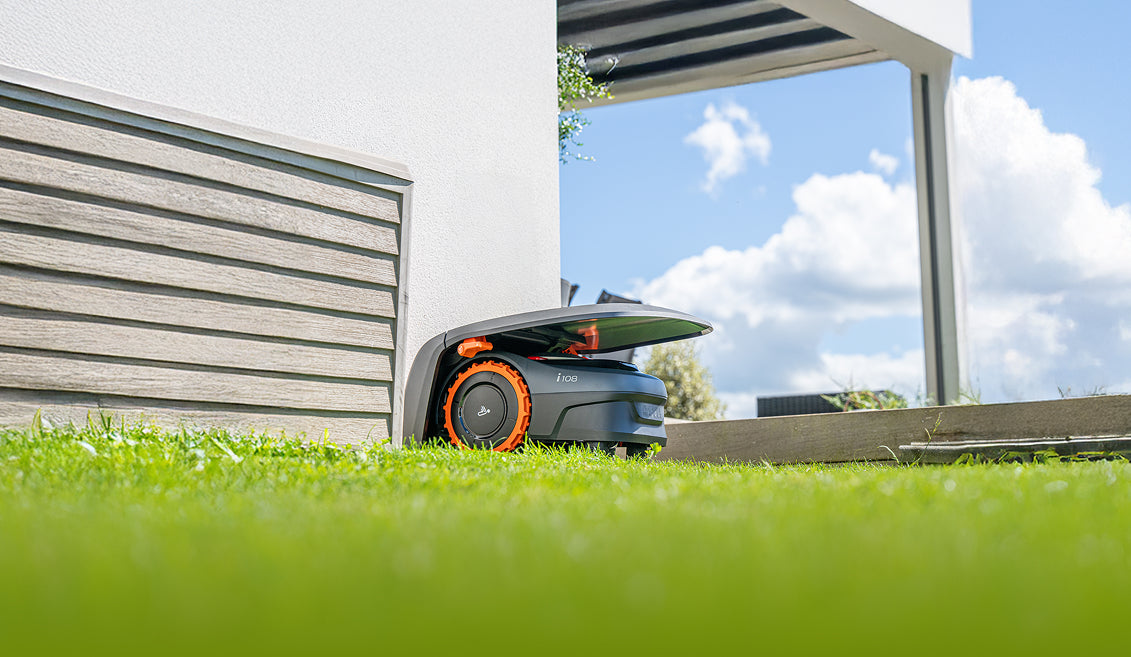
The Navimow i105N is the cheapest way into a real wire-free robot mower for a small American yard. RTK plus vision keeps it on the right side of the fence without burying any wire.
As an Amazon Associate we earn from qualifying purchases — at no extra cost to you.
Full specifications
Below is the full hardware sheet we pulled directly from Segway for the Navimow i105N, cross checked against current product documentation so you can size it against your yard before buying. On paper this machine pairs a 27.56-inch cutting width with a 252 Wh battery for roughly 90 minutes of runtime per charge, weighing about 20.94 lbs and is rated IPX5 against rain and sprinklers. It handles slopes up to 45%, which is the number that usually decides whether a mower will work on a given lawn.
| Cutting width | 27.56 in |
| Cutting height | 0.79 to 2.76 in |
| Blade type | fixed bar blade |
| Blade count | 3 |
| Battery | 252 Wh |
| Battery type | Li-ion 18V |
| Runtime | 90 min |
| Charge time | 60 min |
| Weight | 20.94 lbs |
| Wheel drive | 2WD |
| Max slope | 24° (45%) |
| Weather rating | IPX5 |
| Rain sensor | Yes |
| Noise level | 65 dB |
| Obstacle avoidance | ultrasonic |
| Multi-zone | No |
| Connectivity | Wi-Fi, Bluetooth |
| App platforms | iOS, Android |
| Anti-theft | PIN code, GPS tracking, lift sensor, alarm |
| Dock type | standard outdoor dock |
| Warranty | 2 years |
| Released | 2026 |
- Coverage
- ~0.12 acre (≈5,200 sq ft)
- Navigation
- RTK GPS + Vision
Standout features
These are the specific things the Navimow i105N does better than the average robot mower in its price band. We pulled them from manufacturer documentation and aggregated long-term owner feedback, and weighted features that actually change day to day mowing rather than spec sheet trivia.
- • True wire-free at an entry price
- • Easy 20–30 min app-guided perimeter setup
- • Vision-assisted obstacle detection
Pros
The strengths below are the reasons buyers keep the Navimow i105N after the novelty wears off. Each point reflects something owners consistently confirm in long-term reviews or that Segway backs with a clear specification, not marketing language.
- + No boundary wire to install
- + Quick app-guided setup in under 30 minutes
- + Reliable on smaller, simple yards
- + Quiet enough for HOA neighborhoods
Cons
Every robot mower involves trade offs. The drawbacks below are the ones most likely to bite a real owner of the Navimow i105N, ranked by how often they come up in long term use rather than by how dramatic they sound on a feature list.
- − Coverage tops out around 5,000 sq ft
- − Needs clear sky for the RTK antenna
- − Single cutting disc only
Who it's for
The Navimow i105N is built around a specific kind of lawn and a specific kind of owner. If your yard and habits match the profile below, it tends to be one of the easiest robot mowers in its class to live with. Best fit categories on our list: small-yards, wire-free, budget.
Homeowners with a sub–quarter-acre lawn who want hands-free mowing without digging in a boundary wire.
Who should skip
Picking the wrong robot mower is expensive, so it is worth being honest about who should walk away from the Navimow i105N. If any of the situations below describe your yard, expect frustration and look at one of the alternatives at the bottom of this review instead.
Anyone with more than about 5,000 sq ft of grass, heavy tree cover blocking GPS, or steep slopes above 25°.
Setup
Because this model is wire free, setup is mostly an app driven mapping walk rather than a trenching job, which is the biggest practical reason most buyers choose it. The RTK reference antenna needs a clear view of the sky, so dock placement matters more than people expect. Segway ships it with a standard outdoor dock that handles charging and, on most installs, doubles as the home reference point for navigation.
Plug in the dock, mount the RTK antenna in clear sky, walk the perimeter once in the app. Typically 20–30 minutes.
Real-world performance
Spec sheets only get you so far. This is how the Navimow i105N actually behaves once it is mapped, scheduled and left to run for a few weeks across a real lawn with kids, pets, sprinklers and the occasional fallen branch in the way.
Tight, neat passes on open turf. Slightly conservative around obstacles compared to lidar-equipped competitors.
App experience
Most of the daily relationship with a robot mower happens inside its phone app, not on the mower itself. The Navimow i105N is controlled from the Segway app on iOS and Android, and the quality of that software has a bigger effect on satisfaction than almost any hardware spec.
The Navimow app is one of the cleanest in this segment — scheduling, zones, and rain delay all on one screen.
Noise
Robot mowers earn their keep partly by being quiet enough to run at hours a gas mower never could. The Navimow i105N is rated around 65 dB at operator distance, which is the number that decides whether you can schedule it at dawn without a neighborly conversation.
Quiet enough to run during morning hours without complaints — measured well below most gas mowers.
Maintenance
A robot mower is a small outdoor robot that lives in your grass, so it needs a little routine care to keep cutting cleanly and to hit its warranty period. It uses 3 fixed bar blade, which set the rhythm for how often you swap blades and what they cost. Below are the maintenance tasks specific to the Navimow i105N.
Three small swing-blades to swap every 1–3 months. Rinse the deck with a low-pressure hose.
Ready to buy?
Listings rotate frequently on Amazon — we keep this link pointed at live results in the Robotic Lawn Mowers category.
Alternatives to consider
If the Navimow i105N is close to right but not quite, the models below are the ones our editors most often recommend instead. Each one solves a slightly different problem, whether that is bigger coverage, steeper hills, a lower price or a different navigation philosophy.
- Navimow i108E — Best for Small Yards
- Navimow i2 AWD (i206) — Best Wire-Free for Hills
- Navimow X350 — Best for Very Large Yards