How Do Robot Lawn Mowers Work? Plain-English Guide
A neutral, jargon-free walkthrough of what's actually going on inside the dock, on the lawn, and in the app.
If you’ve ever sat on your porch watching a plastic beetle-shaped machine crawl across your neighbor’s lawn, you’ve probably asked yourself: how do robot lawn mowers work, and why isn't it hitting the flower beds? To the casual observer, it looks like a mix of magic and luck. To the owner, it’s a relief from weekend chores.
The short answer is that a robot mower is a mobile computer powered by a lithium-ion battery that uses a combination of sensors, navigation logic, and high-speed spinning blades to maintain a consistent grass height. Unlike your push mower, which you use once a week to hack off two inches of growth, a robot mower lives on the lawn, cutting just a few millimeters every day. Here is the plain-English breakdown of the hardware and software making it happen.
The Navigation: How It Stays on the Property
The biggest question people have is how the mower knows where the lawn ends and the driveway begins. Historically, there was only one way to do this, but the industry is currently split between two main technologies.
Boundary Wires (The "Digital Fence") Classic models, like the Husqvarna Automower 300-series or the Worx Landroid, rely on a low-voltage wire buried just an inch under the turf or stapled down with stakes. This wire connects to the charging dock, creating a continuous loop. The dock sends a radio signal through the wire, which the mower picks up via onboard sensors. When the mower gets close to the wire, it "hears" the signal, stops, and turns around. It is reliable, but a pain to install and a headache if you accidentally cut the wire while gardening.
Wire-Free Navigation (GPS and Vision) The newer generation of mowers—think the Segway Navimow, Mammotion LUBA, or the Husqvarna EPOS line—uses "RTK-GPS." This is high-precision satellite positioning that is accurate down to about an inch. These mowers require a reference station (a small antenna) placed on your roof or a pole. Other brands, like the Ecovacs Goat or Eufy models, use 3D cameras or "beacons" placed around the yard to navigate through visual landmarks. These are much easier to set up because you "drive" the mower around the perimeter with a smartphone app to create a digital map.
The Cutting System: Razor Blades vs. Heavy Plates
If you look under a standard gas mower, you’ll see one giant, heavy steel blade. Robot mowers don't work like that. Because they are battery-powered, they need to be efficient.
Most robots, including those from Anthbot Genie or Worx, use a spinning disk with three or four small blades attached to the edges. These blades look exactly like heavy-duty razor blades or box-cutter tips. They are "free-swinging," meaning if they hit a rock or a tough stick, they flick inward to avoid breaking.
Because the robot mows every day (or every other day), it is only ever cutting "micro-clippings." These clippings are so small they disappear into the soil immediately, acting as a natural fertilizer. You’ll never have to bag grass again, but you also can't let your grass grow six inches tall before turning the robot on; it will simply choke.
Logic and Patterns: Random vs. Systematic
How the mower actually covers the ground depends on the brain inside the machine. This is often where the "budget" models are separated from the premium ones.
- Random Bounce: This is the "Roomba style" of mowing. The mower drives in a straight line until it hits the boundary wire or an obstacle, then turns a random number of degrees and heads off again. While it looks inefficient, over the course of several hours, it eventually hits every blade of grass.
- Systematic Striping: High-end models like the Mammotion LUBA or the Ecovacs Goat map the yard and mow in efficient, back-and-forth parallel lines. This is much faster and results in those "stadium stripes" many homeowners crave.
- Multi-Zone Management: Most modern apps allow you to divide your yard into "Zone A" and "Zone B." You can tell the robot to spend 60% of its time in the large backyard and 40% in the small front strip.
Safety and Obstacle Detection
A common concern is what happens when the mower encounters a dog, a child's toy, or a stray garden hose. To handle this, units are packed with "bump sensors." If the mower's outer shell touches an object, it immediately stops its blades and reverses.
However, the "bump and turn" method isn't perfect for small objects. This is why brands like EcoFlow and Segway are increasingly using AI cameras and LiDAR (the same tech in self-driving cars). These mowers can see a pair of flip-flops or a sleeping pet from several feet away and steer around them without making contact.
Pro Tip: Even the smartest mower can get stuck on a fallen pine branch or an apple. If you have a "messy" yard with lots of debris, you'll spend more time "rescuing" your robot than it's worth.
The Charging Dock: The Home Base
The charging dock is the heart of the operation. It must be plugged into an outdoor GFCI outlet. When the mower’s battery drops to a certain level (usually around 15-20%), it stops mowing and uses its map or a "guide wire" to find its way back to the station.
The mower docks itself, recharges for 60 to 90 minutes, and then heads back out to finish the job. If it rains, most mowers have a "rain sensor" that tells them to head home and stay docked until the grass is dry, as cutting wet grass is inefficient and messy.
The App: Your Remote Control
Technically, you can run most robot mowers without ever opening an app, but you'd be missing out. The app is where you set the "mowing schedule" (e.g., M-W-F from 10:00 AM to 4:00 PM) and adjust the cutting height. While some older models require you to turn a physical knob to change the height, many now allow you to do it electronically through your phone. This is also where you'll receive "Help!" notifications if the mower manages to get itself high-centered on a tree root.
Bottom Line
Understanding how do robot lawn mowers work helps take the "gizmo" factor out of the purchase. They are essentially maintenance tools designed to keep a lawn at a constant state of "just cut," using either physical wires or satellites to stay within bounds. If you have a relatively flat yard and a nearby power outlet, they are a remarkably effective way to get your Saturday mornings back.
Buying Guide
Read now →Mowers mentioned
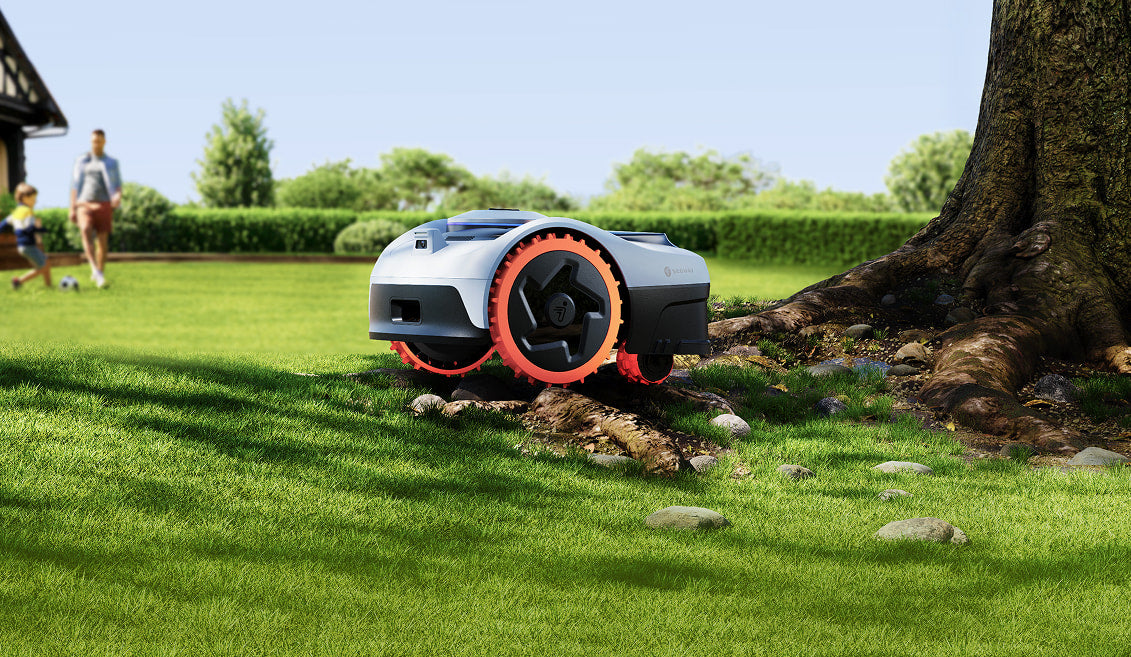
Navimow i108E
- Coverage
- ~0.2 acre (≈8,700 sq ft)
- Max slope
- ~24° (≈45%)
- AWD
- No
If your lawn is up to about an eighth of an acre and you want the simplest wire-free experience on the market, the i108E is hard to beat.
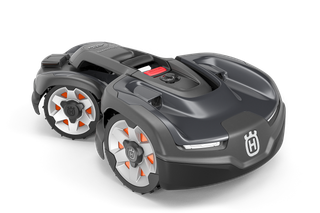
Husqvarna Automower 415X
- Coverage
- ~0.4 acre (≈17,000 sq ft)
- Max slope
- ~22° (≈40%)
- AWD
- No
Boring in the best way. Husqvarna's 415X has been polished over a decade of Automower releases — set it up once and it runs for years.
Related guides
- Are Robot Lawn Mowers Worth It? 2026 Cost Breakdown
Five-year math against a gas mower and a lawn service — with real American pricing, not press-release numbers.
- Best Robot Mowers for Steep & Sloped Yards (AWD Explained)
Slope percent vs. degree, why AWD matters, and which mowers actually keep their grip on real American hill yards.
- Are Robot Lawn Mowers Safe Around Dogs and Kids?
What the sensors actually detect, how fast the blades stop, and which features matter most for households with pets and kids.
- See our full ranking of the best robot mowers →