How Noisy Are Robot Lawn Mowers? Decibel Comparison
Manufacturer-rated noise levels at one meter, ranked, with a quick HOA cheat sheet.
One of the biggest selling points of switching to a battery-powered robot is the promise of a quiet backyard. We’ve all been there: it’s a beautiful Saturday morning, you’re trying to enjoy a coffee on the porch, and the neighbor fires up a gas-powered zero-turn that sounds like a small aircraft taking off. It ruins the vibe instantly.
The short answer is that almost every robot lawn mower on the market is significantly quieter than its gas-powered ancestors. While a traditional walk-behind gas mower scream at roughly 90 to 105 decibels (dB), most robot mowers operate between 50 dB and 65 dB. In plain English, that’s the difference between standing next to a chainsaw and having a quiet conversation in a library. However, "quiet" is a spectrum, and as these machines add more power and faster blades, some are starting to get a bit chatty.
Understanding the Decibel Scale (and Why it Matters)
Before we look at the numbers, it helps to remember that the decibel scale is logarithmic, not linear. An increase of 10 dB represents a sound that is ten times more intense and roughly twice as loud to the human ear.
For the sake of your sanity (and your neighbors), the robot lawn mower noise db level usually sits in the "background noise" category. To give you a frame of reference:
- 30 dB: A soft whisper.
- 50 dB: A quiet refrigerator or a calm suburb at night.
- 60 dB: A standard conversation or a large office.
- 70 dB: A vacuum cleaner or hair dryer.
- 90+ dB: A gas-powered lawn mower (requires hearing protection).
Most robot mowers are quiet enough to run at 2:00 AM without waking you up, provided they aren't bumping into a metal fence or crossing a loud gravel driveway.
The Quietest Contenders: Husqvarna and Worx
Historically, Husqvarna has been the gold standard for silence. The Automower series, particularly the 400 and 500-level professional models, often clocks in at a staggering 58 to 60 dB. Because they use small, razor-like blades on a rotating disk rather than one heavy, solid blade, the "whir" is almost imperceptible from 20 feet away.
The Worx Landroid is another strong performer in the silence department. It typically sits right around the 60 to 63 dB mark. On a well-manicured lawn, you might not even realize it’s running until it’s nearly at your feet. These models are ideal if you have a tight residential lot where your windows are only 15 feet from your neighbor’s bedroom.
The New Wave: High-Power Noise Levels
Lately, we’ve seen a shift in the market toward "all-terrain" and "high-efficiency" mowers like the Mammotion LUBA 2 or the EcoFlow Blade. These machines often trade a bit of silence for raw power.
Because the LUBA uses dual cutting disks and handles thicker, taller grass that an Automower might struggle with, it generates more windage and mechanical noise. You can expect these more aggressive mowers to land in the 65 to 70 dB range. While that is still much quieter than gas, it is a noticeable "hum" that you will definitely hear if you are sitting outside.
The Segway Navimow and the Ecovacs Goat G1 sit somewhere in the middle, generally hovering around 62 to 65 dB. They are quiet enough to be ignored, but you won't forget they are there if they are working right next to your patio.
Measured Noise Levels: A Meter-Away Cheat Sheet
When manufacturers give you a "dB" rating, they are often measuring it under perfect conditions. In the real world, hitting a twig or mowing over dry, crunchy leaves will spike that number. However, if we look at the average robot lawn mower noise db levels measured at a distance of one meter (about three feet), the rankings generally look like this:
- Husqvarna Automower 430X: ~58-59 dB (The "Ninja")
- Worx Landroid S/M: ~60-63 dB (Very quiet)
- Segway Navimow i Series: ~58-62 dB (Impressive for the price)
- Mammotion LUBA 2: ~65-68 dB (Powerful, but audible)
- Anthbot Genie: ~62-65 dB (Solid middle ground)
- EcoFlow Blade: ~62-65 dB (Moderate hum)
Pro Tip: The type of grass matters. Mowing thick St. Augustine or tall Fescue will always be louder than trimming a maintained Kentucky Bluegrass lawn because the motor has to work harder and the blades create more friction against the grass blades.
HOA and Night Mowing: The "Social" Factor
One of the best things about owning a robot is "set it and forget it" scheduling. But can you actually run these at night in a neighborhood with a strict Homeowners Association (HOA)?
In almost every case, the answer is yes. Most city noise ordinances kick in around 55 to 60 dB at the property line. Since sound dissipates quickly over distance, even a 65 dB mower will likely register well below 40 dB by the time the sound reaches your neighbor’s window.
The HOA Cheat Sheet:
- Under 60 dB: Safe to run 24/7. Your neighbors won't even know it's there.
- 60-65 dB: Safe for daytime and evening. If you run it at night, keep it away from bedroom windows.
- Over 65 dB: Stick to 7:00 AM – 9:00 PM to be a "good neighbor," though it's still unlikely to trigger a formal complaint.
What Actually Makes the Noise?
It isn't just the cutting motor. There are three main sources of noise in a robot mower:
- The Blade Motor: The "whir" of the spinning disk. Razor-style blades (Husqvarna, Worx, Navimow) are much quieter than "swing" or "fixed" heavy blades.
- The Drive Motors: The "electronic whine" you hear when the mower climbs a hill or turns. Cheaper models often have noisier gearboxes.
- The Environment: The sound of plastic wheels "clunking" over a sidewalk or the shell vibrating when the mower hits a bump.
If your mower suddenly gets louder, check the blades. A chipped or unbalanced blade will create a vibration that makes the whole machine drone like a propeller plane.
Bottom Line
If your primary goal is total silence for a small suburban lot, look toward the Husqvarna Automower or the Segway Navimow. If you have a massive, rugged property and need the power of a Mammotion LUBA, you’ll have to accept a slightly louder hum—but even then, it’s still significantly quieter than your neighbor’s "quiet" electric walk-behind mower.
Best Mowers
Read now →Mowers mentioned
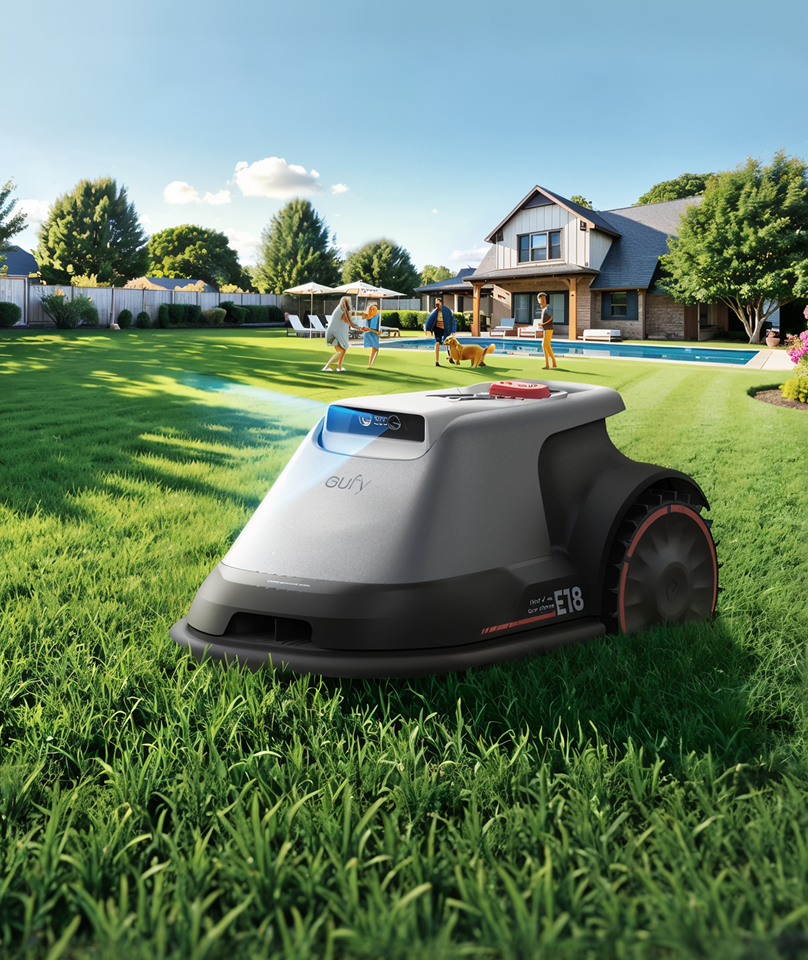
eufy Robot Mower E15
- Coverage
- ~0.2 acre (≈8,700 sq ft)
- Max slope
- ~20° (≈36%)
- AWD
- No
If quiet matters — early mornings, fussy neighbors, an HOA — the eufy E15 is the easiest robot mower in this list to live with.
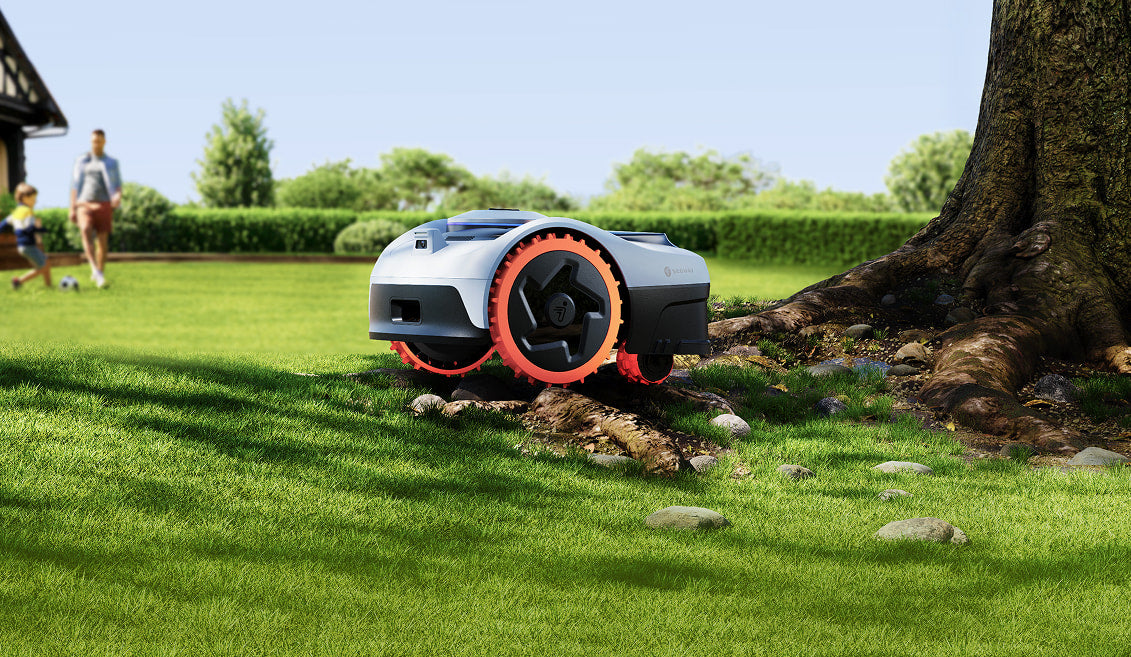
Navimow i108E
- Coverage
- ~0.2 acre (≈8,700 sq ft)
- Max slope
- ~24° (≈45%)
- AWD
- No
If your lawn is up to about an eighth of an acre and you want the simplest wire-free experience on the market, the i108E is hard to beat.
Related guides
- How Do Robot Lawn Mowers Work? Plain-English Guide
A neutral, jargon-free walkthrough of what's actually going on inside the dock, on the lawn, and in the app.
- Are Robot Lawn Mowers Worth It? 2026 Cost Breakdown
Five-year math against a gas mower and a lawn service — with real American pricing, not press-release numbers.
- Best Robot Mowers for Steep & Sloped Yards (AWD Explained)
Slope percent vs. degree, why AWD matters, and which mowers actually keep their grip on real American hill yards.
- See our full ranking of the best robot mowers →