Do You Still Need to Edge With a Robot Mower?
Why there's a strip near your fence the mower never seems to touch — and the three ways to fix it.
The short answer is yes—for about 95% of yards, you will still need to keep your string trimmer or manual edger in the tool shed. While robot mowers are incredible at maintaining the "carpet look" on the main flat areas of your lawn, they have a physical limitation: the blades are almost always tucked safely away from the edge of the machine's plastic chassis for safety.
In most setups, this leaves a gap between where the blade can reach and the edge of your fence, wall, or raised flower bed. This gap is known as the robot mower edging uncut strip, and unless you plan your landscaping specifically to cater to the robot, it’s a reality you’ll have to deal with every few weeks.
Why the "Uncut Strip" Exists
If you look at the bottom of a traditional walk-behind push mower, the blade usually reaches very close to the edge of the deck. Robot mowers are different. Because these machines operate autonomously while people and pets might be nearby, manufacturers are terrified of a spinning blade coming into contact with a stray toe or a dog's paw.
To prevent accidents, most robot mowers—from the entry-level Worx Landroid to the high-end Husqvarna Automower—place the cutting disk dead-center or within a protective guard well away from the outer shell. When the mower's bumper hits your fence or its software tells it to stop at the boundary wire, the blade is still 3 to 6 inches away from the actual edge. This leaves a fringe of tall grass that sticks out like a sore thumb against a perfectly manicured lawn.
The Exception: Mowers with "Cut to Edge"
Some manufacturers have tried to solve this with specialized designs. The Worx Landroid is perhaps the most famous for its "Cut to Edge" feature, which offsets the blade disk to one side of the machine. This allows it to get significantly closer to walls than a centered blade.
More recently, we’ve seen high-tech entries like the Mammotion LUBA 2 and the Segway Navimow, which use precise GPS (RTK) technology. These mowers allow you to program the machine to overlap the boundary slightly. However, even with these "tight" cutters, the physical shell of the mower still prevents it from getting into tight 90-degree corners or rubbing directly against a brick wall without scratching the expensive plastic housing.
Three Ways to Solve the Edging Problem
If you hate the idea of pulling out the string trimmer every Saturday, you have three real-world options to deal with that robot mower edging uncut strip.
1. The Low-Tech Fix: Hardscaping
The most effective way to eliminate manual edging is to give your robot a "runway." By installing a flat border—like flagstones, bricks, or pavers—at the same level as the soil, the robot can drive one wheel over the stones. This allows the blades to reach the very edge of the grass.
- Pros: Permanent solution; looks professional.
- Cons: High upfront cost or labor to install.
2. The Maintenance Routine: The Monthly Trim
Because robot mowers cut just a few millimeters of grass every day, the lawn stays very short. This actually makes the uncut fringe less noticeable than it would be with a traditional mower. Many owners find that they only need to go around the perimeter with a string trimmer once every two or three weeks.
- Pros: No yard renovations required.
- Cons: You’re still doing manual labor.
3. The "No-Grip" Zone: Mulch and Bark
Instead of grass growing right up to your fence or foundation, you can pull the turf back about 6 to 8 inches and replace it with mulch, decorative gravel, or wood chips. You then set your boundary wire or virtual map so the robot's nose pokes into the mulch.
- Pros: Cheap and easy to do over a weekend.
- Cons: You have to maintain the mulch levels so the mower doesn't get stuck in a rut.
Pro Tip: If you are using a mower with a boundary wire (like an older Husqvarna or a base-model Eufy), spend extra time during installation to "pin" the wire as close to obstacles as the manual allows. Every inch you save during setup is an inch you don't have to trim later.
Do Navigation Systems Matter for Edging?
Lately, the industry has shifted away from buried wires and toward "wire-free" navigation. You’ll see brands like Ecovacs and EcoFlow using LiDAR or cameras, while Mammotion and Segway use RTK-GPS.
Does this help with the robot mower edging uncut strip? Yes and no. High-end GPS mowers are much better at following a precise line than a mower bouncing off a wire. However, GPS signals can "drift" near tall walls or under heavy tree cover. If your robot thinks it’s four inches to the left of where it actually is, it might leave a wider strip or, worse, scrape itself against your siding. If you have a yard with lots of "signal shadows," a traditional wire-based mower often provides a more consistent (if slightly wider) edge.
New Tech on the Horizon
We are starting to see the first "hybrid" robots that try to tackle the edging problem with secondary tools. Some newer models, like the Anthbot Genie or certain specialized Chinese imports, are experimenting with side-mounted trimmers or articulating arms.
While these look promising in YouTube demos, I’m generally skeptical of adding more moving parts to a machine that lives outside in the rain and dirt. For now, the most reliable "technology" for a clean edge remains a flat paver or a steady hand with a Black & Decker string trimmer.
Bottom Line
You should buy a robot mower to reclaim the hours you spend walking behind a loud, gas-swilling machine, but don't expect it to retire your weed whacker entirely. Unless you're willing to install flat "mowing strips" or mulch borders around your entire perimeter, you’ll still need to do a 10-minute lap of the yard every couple of weeks to clean up the edges.
Buying Guide
Read now →Mowers mentioned
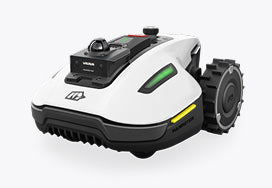
Mammotion YUKA 2000
- Coverage
- ~0.5 acre (≈22,000 sq ft)
- Max slope
- ~27° (≈50%)
- AWD
- No
The YUKA 2000 reads more like a robotic groundskeeper than a mower. Dual discs plus a clipping sweeper give it the cleanest finish in the wire-free class.
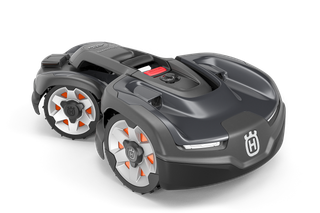
Husqvarna Automower 415X
- Coverage
- ~0.4 acre (≈17,000 sq ft)
- Max slope
- ~22° (≈40%)
- AWD
- No
Boring in the best way. Husqvarna's 415X has been polished over a decade of Automower releases — set it up once and it runs for years.
Related guides
- Can Robot Mowers Handle Wet Grass? What Actually Happens
The honest answer the manufacturer pages skip — including what wet grass does to blades, decks, and your stripes.
- Why Is My Robot Mower Leaving Uncut Patches? (Fixes)
Six causes, ranked from most to least common — and the diagnostic steps to find which one is yours.
- Robot Mowers and Leaves: Do They Mulch in Fall?
Yes, no, and "it depends on how thick" — plus the fall maintenance moves that protect your blades.
- See our full ranking of the best robot mowers →