Robot Mowers and Leaves: Do They Mulch in Fall?
Yes, no, and "it depends on how thick" — plus the fall maintenance moves that protect your blades.
Yes, no, and "it depends." If you were hoping your robot mower would replace your heavy-duty leaf vacuum or the teenager you hire to rake the lawn every November, I have some disappointing news. Most robot mowers are designed to maintain a manicured lawn, not to act as industrial-strength mulchers.
The short answer is that a robot mower can handle a light dusting of dry leaves by chopping them into tiny bits that disappear into the thatch. However, once the heavy leaf drop begins, most robots will either struggle, get stuck, or simply ride right over the top of the debris without doing much of anything. Understanding how a robot mower handles leaves in the fall requires looking at how these machines actually cut grass compared to a traditional gas mower.
The Problem With Those Tiny Blades
To understand why a robot mower leaves fall cleanup isn't always effective, you have to look underneath the machine. Most popular models—including the Husqvarna Automower, Segway Navimow, and Worx Landroid—use a "razor blade" system. These are small, pivoting blades attached to a spinning disc.
Standard lawn mowers use a massive, heavy steel blade that creates "lift" (suction). This suction pulls the grass and leaves upward into the cutting path. Robot mowers, by design, have almost zero lift. They are built for efficiency and quiet operation. When a robot encounter a thick, wet maple leaf, the leaf usually just stays flat against the ground while the razor blades skim uselessly over the top. If the blades do strike a thick pile of leaves, they are more likely to dull prematurely or get "pinned" back by the debris, stopping them from spinning entirely.
Dry Leaves vs. Wet Leaves
If your yard is covered in a light layer of dry, crispy oak leaves, your robot might actually do a decent job. As the mower passes over them, the blades will shatter the brittle leaves into small flakes. This is actually great for your soil, as it returns nutrients to the turf.
However, once it rains or the morning dew sets in, things go south quickly. Wet leaves become a slippery, heavy mat. Not only will the mower fail to cut them, but the leaves can also cause traction issues. Models like the Mammotion LUBA 2 or the EcoFlow Blade have AWD or rugged tires that handle slick conditions better than others, but even they can't mulch a wet, soggy layer of sycamore leaves. In many cases, the wet leaves will stick to the underside of the chassis, clogging the cutting disc and forcing you to flip the mower over for a messy cleaning session.
RTK vs. Wire: The "Hidden" Leaf Risk
There is a technical hurdle to using a robot mower leaves fall season that many owners don't consider until it's too late: navigation. If you have an older-style mower that uses a perimeter wire, the leaves won't affect the navigation, but they might hide obstacles (like a fallen branch or a dog toy) that can damage the blades.
If you use a high-end "wire-free" mower like the Ecovacs Goat or the Eufy S1 Pro, leaves can be more annoying. Some of these mowers use 3D cameras and LiDAR for obstacle avoidance. In the peak of fall, the sensors might perceive a large, blowing pile of leaves as a solid object—like a rock or a pet. The mower will then "evade" the leaves, leaving patches of your grass completely uncut. It’s a frustrating loop: the mower won't cut the leaves because it thinks the leaves are something it needs to avoid.
Can Any Robot Actually Clean Up Leaves?
If you are determined to find a robot that can handle a heavier leaf load, you have to look for models that use "swinging" or fixed blade systems rather than the tiny razors.
- The yuka-2000" class="text-primary font-medium hover:underline">Mammotion Yuka: This is one of the few consumer-grade robots specifically marketed with a leaf-sweeper attachment. It literally tows a hopper that brushes leaves off the grass and into a bag. It’s expensive, but it’s the closest thing to a "hands-off" fall cleanup currently on the market.
- Anthbot Genie: This newcomer uses a more traditional single-blade system rather than a disc of razors, which gives it a slight edge in chopping up light debris.
- Worx Landroid: While it uses razors, the "Cut to Edge" design and the ability to manually adjust the height easily make it a favorite for people who want to try and mulch light fall debris.
Even with these models, the golden rule remains: you cannot ignore the yard for three weeks in October and expect the robot to clear a four-inch thick carpet of wet leaves.
Best Practices for Fall Mowing
If you want to maximize your robot mower leaves fall performance, you need a strategy. You can't just set it and forget it like you do in July.
- Keep the Mower Running: Don't wait for the leaves to accumulate. If the robot runs every day, it will chop the leaves as they fall, one by one, before they have a chance to form a mat.
- Raise the Cutting Height: As the leaves start dropping, raise your deck height. This prevents the mower from "plowing" through the leaves and allows the blades to strike the leaves from a better angle.
- Clean the Underbelly Weekly: During the fall, check the underside of your mower twice as often as usual. Scrape away the "leaf paste" that builds up around the cutting disc to keep the blades spinning freely.
- The "Pre-Rake" Strategy: You’ll still need your rake or blower. Use them to move heavy piles out of corners and back onto the main lawn where the mower has a better chance of hitting them.
Bottom Line
A robot mower is a maintenance tool, not a cleanup tool. While it can handle a light dusting of dry leaves, it will never replace a dedicated leaf blower or a high-suction gas mower for a true fall cleanup. If you have heavy tree cover, plan on doing one final "big rake" yourself before tucking your robot away for the winter.
Buying Guide
Read now →Mowers mentioned
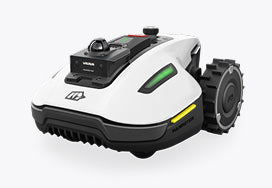
Mammotion YUKA 2000
- Coverage
- ~0.5 acre (≈22,000 sq ft)
- Max slope
- ~27° (≈50%)
- AWD
- No
The YUKA 2000 reads more like a robotic groundskeeper than a mower. Dual discs plus a clipping sweeper give it the cleanest finish in the wire-free class.
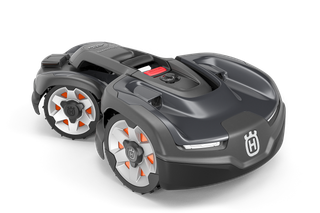
Husqvarna Automower 415X
- Coverage
- ~0.4 acre (≈17,000 sq ft)
- Max slope
- ~22° (≈40%)
- AWD
- No
Boring in the best way. Husqvarna's 415X has been polished over a decade of Automower releases — set it up once and it runs for years.
Related guides
- Can Robot Mowers Handle Wet Grass? What Actually Happens
The honest answer the manufacturer pages skip — including what wet grass does to blades, decks, and your stripes.
- Do You Still Need to Edge With a Robot Mower?
Why there's a strip near your fence the mower never seems to touch — and the three ways to fix it.
- Why Is My Robot Mower Leaving Uncut Patches? (Fixes)
Six causes, ranked from most to least common — and the diagnostic steps to find which one is yours.
- See our full ranking of the best robot mowers →