Can One Robot Mower Cover Two Separate Lawns?
Multi-zone vs. multi-dock vs. just-buy-two — the trade-offs nobody explains.
The short answer is yes, a robot mower two lawns setup is entirely possible, but the "how" depends heavily on whether those lawns are physically connected. If there is a continuous strip of grass or a paved path between them, your mower can likely drive itself back and forth. If they are separated by a five-foot privacy fence or a busy public road, you’re looking at a different—and slightly more manual—workflow.
The reality is that while mower manufacturers love to tout "multi-zone" capabilities, the physical logistics of moving a 30-pound robot between two disconnected islands of grass can become a chore that defeats the purpose of automation. Here is how the trade-offs actually shake out in the backyard.
The "Passage" Scenario: When Your Lawns Are Connected
This is the gold standard. If your front and back yards are connected by a side yard or a driveway, most modern mowers can handle this as a single continuous job.
For traditional wire-based mowers like the Husqvarna Automower or Worx Landroid, you simply lay the boundary wire to include both areas, creating a narrow "neck" or passage for the mower to travel through. For wire-free, GPS-based units like the Segway Navimow or Mammotion LUBA, you use the app to map a virtual path (a "channel") across the pavement or mulch.
The catch? Traction and safety. If the path between the two lawns is steep, narrow, or made of loose gravel, the mower might lose its grip or get stuck. If the path crosses a sidewalk where people walk dogs or kids ride bikes, you’re relying on the mower’s object-avoidance sensors to not cause a neighborhood incident.
The "Island" Scenario: No Physical Connection
If your two lawns are separated by a wall, a flight of stairs, or a neighbor’s property, you are dealing with what the industry calls an "isolated zone." In this setup, the robot cannot drive itself to the second location.
To make a robot mower cover two lawns in this situation, you have to physically pick up the mower and carry it to the second yard. Once you set it down and press start, it will mow until the battery dies or the job is done.
The Big Trade-off: When a mower is in an isolated zone, it cannot return to its dock to recharge. If the battery runs out before the grass is cut, the mower just stops in the middle of the yard. You then have to carry it back to the charger. This manual labor is exactly what most people pay four figures to avoid.
RTK-GPS vs. Boundary Wire for Two Lawns
The technology you choose changes how easy it is to manage two zones.
- RTK-GPS (Segway, Mammotion, EcoFlow): These are generally better for complex yards. You don't have to dig trenches or bury wires under a driveway to connect two zones. You simply "drive" the mower via the app to create a map for Yard A, a map for Yard B, and a connecting path. However, if the path between the two lawns is under heavy tree cover or right against a tall brick wall, the mower might lose its satellite signal and "get lost" in transition.
- Boundary Wire (Husqvarna, Worx): These are more reliable in terms of signal, but the installation is a headache for two lawns. Crossing a driveway often requires a masonry blade to cut a small groove in the concrete to bury the wire, which many homeowners (and spouses) aren't thrilled about.
When Two Lawns Require Two Docks
Advanced users sometimes try to "hack" the system by buying a second charging station. Some brands, like Husqvarna, allow you to buy an extra dock and move the mower between two completely separate wire loops.
While this solves the "ran out of battery" problem, docks aren't cheap. They often cost several hundred dollars. By the time you buy a high-end mower and a second dock, you are often approaching the price of just buying two entry-level mowers.
If your front yard is a tiny 1,000-square-foot patch and your back yard is a half-acre, putting a cheap Worx Landroid or a budget-friendly Anthbot Genie in the front and a more robust Mammotion LUBA in the back is often the more "set it and forget it" solution.
Capacity and Wear: The Math Matters
Before you try to make one robot mower cover two lawns, check the "max acreage" rating. If a mower is rated for 0.25 acres and your front and back yards combined are 0.24 acres, that mower is going to be running nearly 24/7 to keep up.
Robot mowers don't cut like a human once a week; they "maintain" by cutting a little bit every day. If the mower spends 30 minutes of its battery life just traveling back and forth between two lawns, or if it's constantly being carried and restarted, the grass will grow faster than the mower can keep up with. Always "overbuy" on capacity if you plan on managing multiple zones.
The New Guard: Vision-Based Systems
The newest players on the scene—like the Ecovacs Goat or Eufy models—use beacons or cameras rather than just GPS or wires. These are promising for multi-lawn setups because they don't care about satellite "view." If the mower's cameras can see the beacons or recognize the environment, it can navigate between zones quite reliably.
However, these systems are still in their early generations. We’ve seen them get confused by things like shiny sliding glass doors or sudden changes in lighting, so they aren't quite the "magic bullet" for separated lawns just yet.
Bottom Line
Using a robot mower for two lawns works best when there is a clear, level path for the robot to travel autonomously. If you have to carry the mower manually, you will likely find the novelty wears off within a month, and you're better off either buying a second unit or sticking with a traditional push mower for the smaller secondary zone.---
Buying Guide
Read now →Mowers mentioned
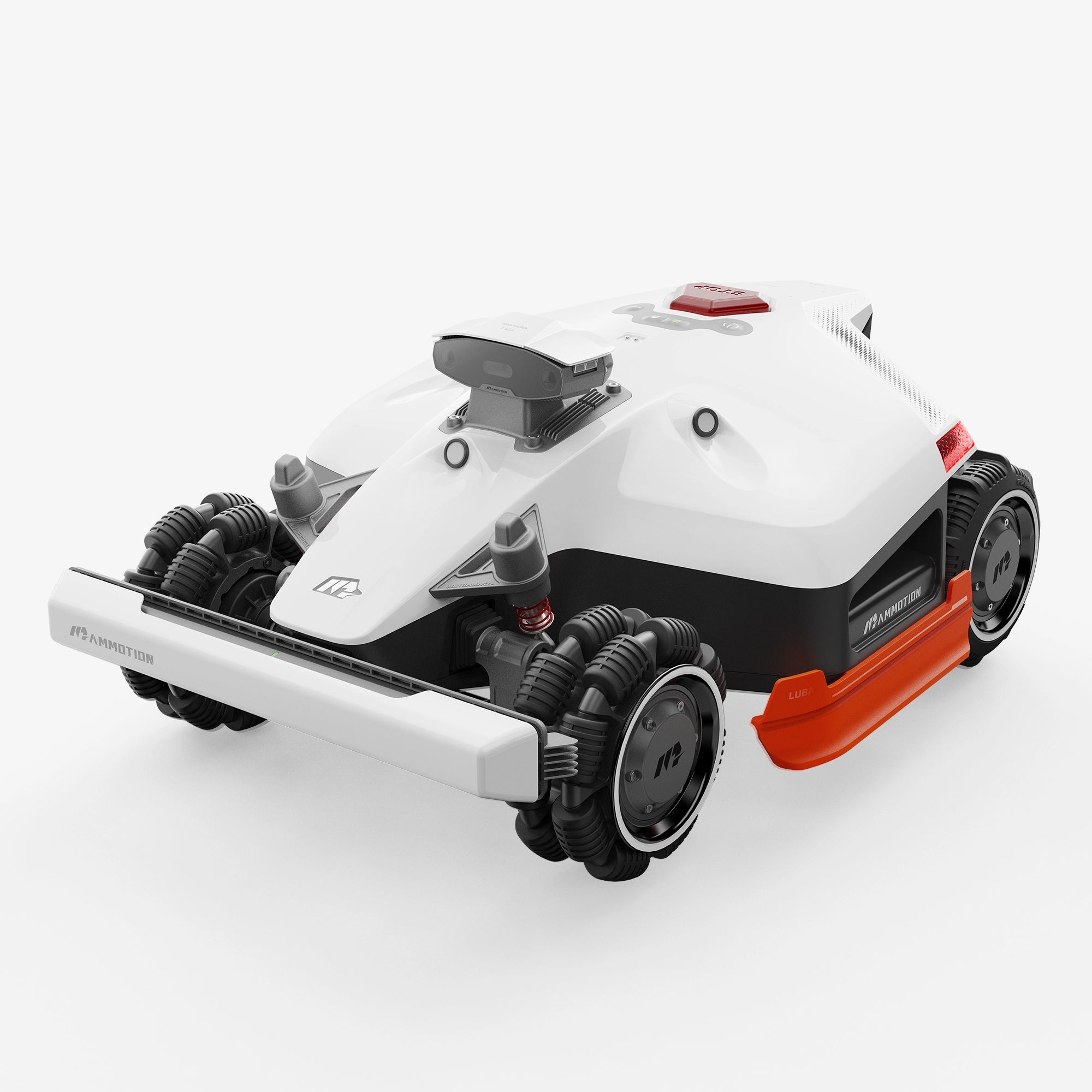
Mammotion LUBA 2 AWD 5000
- Coverage
- Up to ~1.25 acre (≈54,000 sq ft)
- Max slope
- ~38° (≈78%)
- AWD
- Yes
The LUBA 2 AWD 5000 is the wire-free mower for owners of a full acre with hills. Few competitors combine that coverage with serious slope rating.
Husqvarna Automower 415X
- Coverage
- ~0.4 acre (≈17,000 sq ft)
- Max slope
- ~22° (≈40%)
- AWD
- No
Boring in the best way. Husqvarna's 415X has been polished over a decade of Automower releases — set it up once and it runs for years.
Related guides
- Can Robot Mowers Handle Wet Grass? What Actually Happens
The honest answer the manufacturer pages skip — including what wet grass does to blades, decks, and your stripes.
- Do You Still Need to Edge With a Robot Mower?
Why there's a strip near your fence the mower never seems to touch — and the three ways to fix it.
- Why Is My Robot Mower Leaving Uncut Patches? (Fixes)
Six causes, ranked from most to least common — and the diagnostic steps to find which one is yours.
- See our full ranking of the best robot mowers →