Robot Mowers for Rocky or Uneven Ground: What Survives
Which chassis designs survive root bumps, tree wells, and the random brick — and which ones crack a cover.
If your yard looks more like a construction site or a forest floor than a manicured putting green, you’re likely skeptical about whether a robot mower can actually survive the season. Most people assume these machines are fragile plastic toys that will high-center on a stray root or shatter a blade the moment they hit a rogue limestone rock. The short answer is: most entry-level mowers will struggle, but a new generation of "all-terrain" models is specifically designed to handle the abuse.
To find a robot mower for uneven ground, you have to stop looking at the software and start looking at the suspension, ground clearance, and drive system. A mower that gets stuck every twenty minutes isn't a labor-saving device—it’s a high-maintenance pet. Here is what survives the ruts, the rocks, and the tree wells.
Clearance is King (and Most Mowers Lack It)
The biggest enemy of a robot mower on uneven ground isn't the grass height; it's the chassis height. Most residential robots, like the budget-friendly Worx Landroid series, sit very low to the ground to ensure a clean cut and to meet safety standards that prevent hands from reaching the blades. On a flat lawn, this is fine. On a rocky lawn, the plastic "skirt" around the mower acts like a plow, catching on every bump and high-centering the drive wheels.
If your yard has "craters" or exposed roots, you need a mower with adjustable deck height and a high leading edge. Models like the Husqvarna Automower 450X or the newer Segway Navimow series handle transitions better because they have more "float" in their chassis. When the front wheel enters a dip, the body doesn't immediately bottom out. If you buy a mower with 1-inch clearance for a yard with 2-inch protruding rocks, you’re going to be replacing plastic covers by July.
All-Wheel Drive vs. Two-Wheel Drive
Most robot mowers are rear-wheel drive with two small, pivoting "caster" wheels in the front. This is the worst possible configuration for rocky or uneven terrain. When the small front wheels hit a rock or drop into a hole, they get stuck, and the rear wheels just spin until the mower gives up and sends an "I'm stuck" notification to your phone.
For truly difficult terrain, look at All-Wheel Drive (AWD) units. The Mammotion LUBA 2 AWD is currently the "it" mower for this category because its four-wheel drive system mimics a miniature Jeep. It can climb over roots and through ruts that would stop a traditional mower cold. Husqvarna also offers AWD versions of their professional-grade Automowers (like the 435X AWD), which feature an articulated chassis. This allows the front and back of the mower to move independently, keeping all four wheels in contact with the ground even when the terrain is undulating.
The "Floating Deck" Factor
One of the most common ways robot mowers die on rocky ground is "blade strike." If a mower has a fixed cutting disc and it drives over a fixed rock or a thick root, the impact can bend the motor shaft. This is often a "total loss" repair that costs nearly as much as a new unit.
Brands like Mammotion and the newer EcoFlow Blade (though it has its quirks) utilize dual-cutting systems or floating decks. A floating deck is suspended by springs or a pivot, allowing the entire blade assembly to "pop up" when it hits an obstruction rather than taking the full force of the impact.
Pro Tip: Look for mowers that use small, "razor-style" pivoting blades (common on Husqvarna, Worx, and Navimow) rather than a single large, rigid bar blade. If a pivoting blade hits a rock, it just tucks away. If a solid bar blade hits a rock, it transfers that energy directly into the motor.
Surviving the "Random Brick" and Tree Wells
Tree wells are notorious for trapping robot mowers. If the mower's bumper is too sensitive, it will constantly back away from every tuft of grass; if it’s too dull, it will try to climb the tree. On uneven ground, robots often tilt, which can cause their sensors to misinterpret a hill as an obstacle.
The newer "vision-based" mowers, like the Ecovacs Goat G1 or the Eufy S1 Pro, use cameras and LiDAR to see objects before they touch them. For rocky yards, this is a double-edged sword. While it keeps the mower from slamming into a large rock, it might also make the mower overly "timid," leaving large patches of uncut grass around every bump. If your yard has permanent rocky features, you are better off with a mower that allows you to set "no-go zones" via GPS (like the Segway Navimow or Anthbot Genie) so the mower simply avoids the danger zones entirely.
Wheels, Treads, and Weight Distribution
If your uneven ground includes slopes or "mushy" spots, the type of plastic used in the wheels matters. Standard plastic wheels often lose traction on dry grass, let alone on uneven dirt.
- Spiked Wheels: Some brands offer "off-road" kits. These are heavy, aggressive wheels that dig into the turf. They are great for traction but can tear up your lawn if the mower gets stuck and starts spinning.
- Tires vs. Casters: Look for larger-diameter front wheels. The smaller the wheel, the more likely it is to fall into a hole it can't climb out of.
- Weight: Heavier mowers generally handle uneven terrain better because they don't "bounce" as much, but they are also harder to rescue when they do eventually get stuck.
The Bottom Line
If your yard is a minefield of rocks and ruts, avoid the "entry-level" models priced in the mid triple-digits; they simply won't survive. Invest in an AWD platform or a model with high ground clearance and pivoting blades—expect to spend in the low to mid four figures for something that won't require a daily rescue mission. For most people with "problem" yards, the Mammotion LUBA or a high-end Husqvarna AWD remain the only real contenders that can survive the season without a cracked chassis.
Best for Hills
Read now →Mowers mentioned
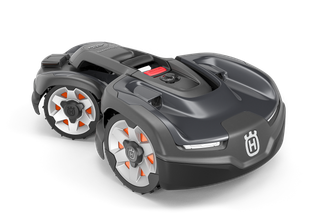
Husqvarna Automower 435X AWD
- Coverage
- ~0.6 acre (≈26,000 sq ft)
- Max slope
- ~70% grade (rated)
- AWD
- Yes
If your yard looks like a ski run, this is still the gold standard. The 435X AWD will mow grades that would tip every other robot mower on the market.
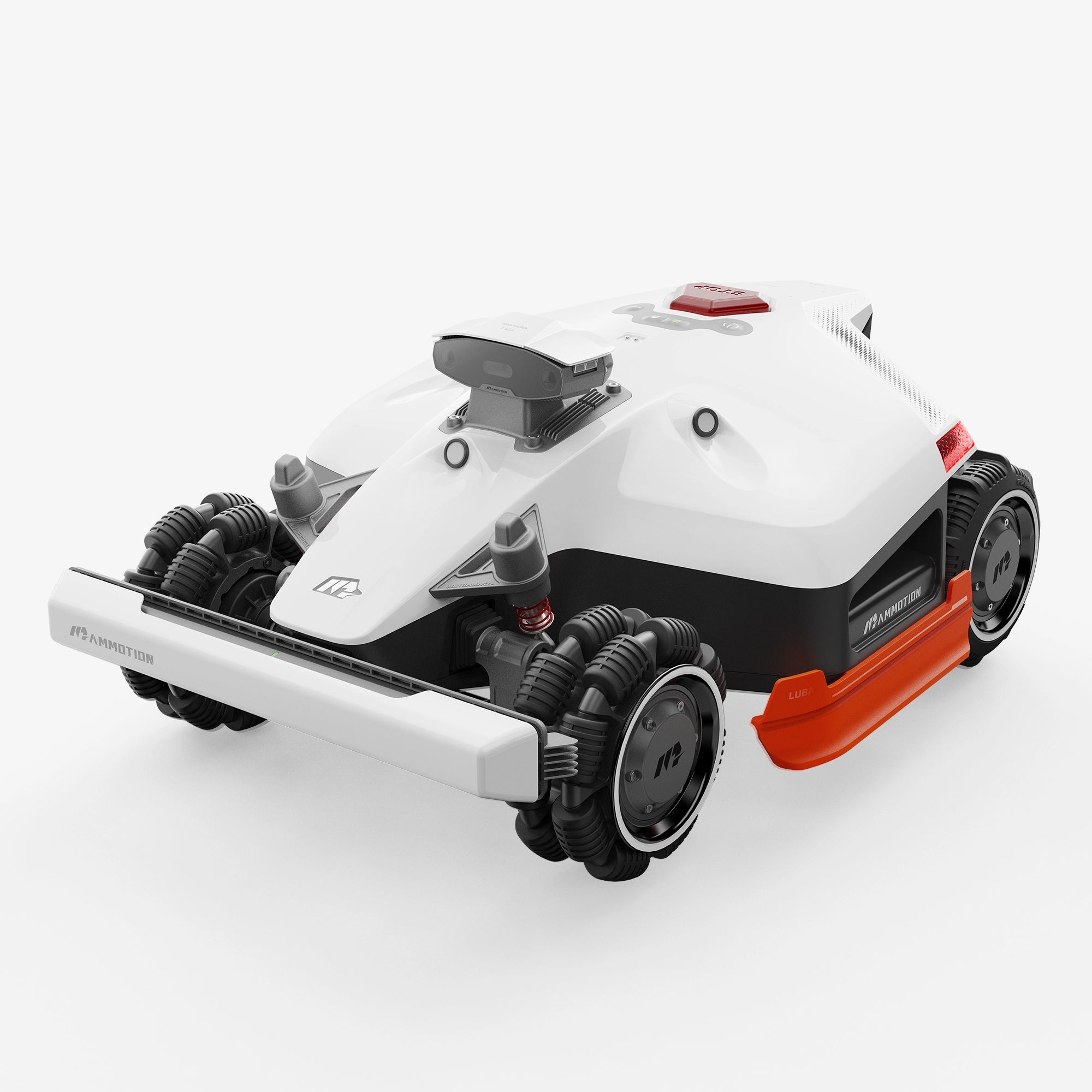
Mammotion LUBA 2 AWD 5000
- Coverage
- Up to ~1.25 acre (≈54,000 sq ft)
- Max slope
- ~38° (≈78%)
- AWD
- Yes
The LUBA 2 AWD 5000 is the wire-free mower for owners of a full acre with hills. Few competitors combine that coverage with serious slope rating.
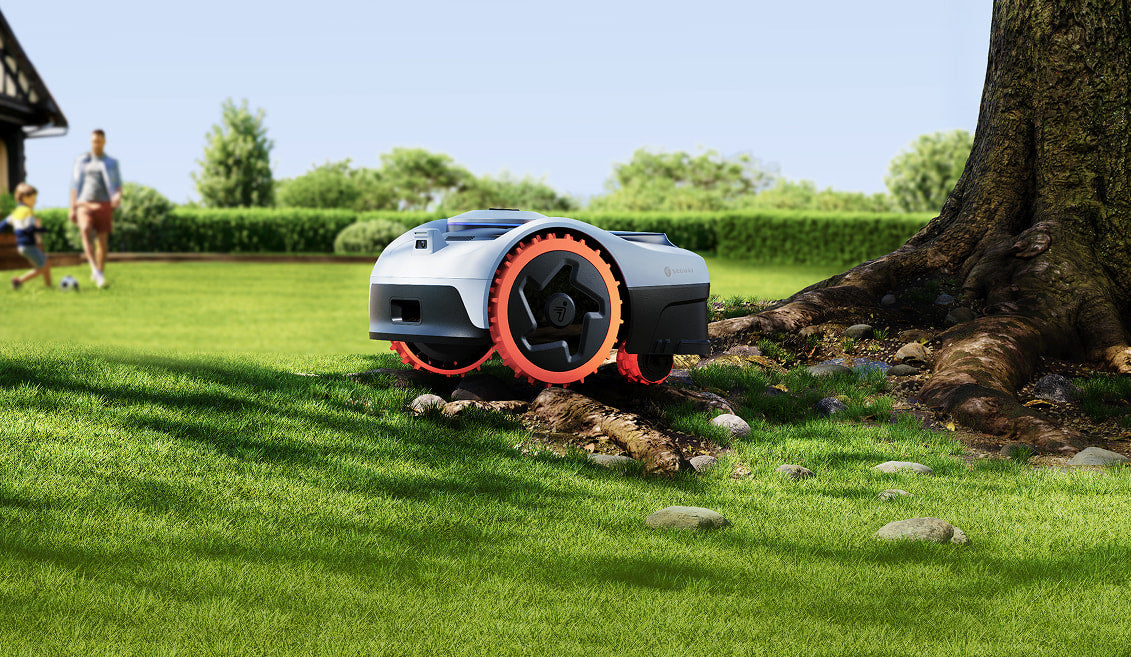
Navimow i2 AWD (i206)
- Coverage
- ~0.15 acre (≈6,500 sq ft)
- Max slope
- ~45% grade
- AWD
- Yes
The Navimow i2 AWD is the easiest way to get true all-wheel drive on a wire-free mower without spending Husqvarna money.
Related guides
- Can Robot Mowers Handle Wet Grass? What Actually Happens
The honest answer the manufacturer pages skip — including what wet grass does to blades, decks, and your stripes.
- Do You Still Need to Edge With a Robot Mower?
Why there's a strip near your fence the mower never seems to touch — and the three ways to fix it.
- Why Is My Robot Mower Leaving Uncut Patches? (Fixes)
Six causes, ranked from most to least common — and the diagnostic steps to find which one is yours.
- See our full ranking of the best robot mowers →